I'm joiningBeverly A Baird&Linda Schuelerin a "year long poetry practice – on the first Friday of each Month," when we, and anyone else who joins, writes a poem and pairs it up with a photo relating to it.
It has been an exceptional year for arrowleaf balsamroot blooms this year. The hills across the valley from us are a haze of yellow. All the photographers I know have been nearly swooning over their abundance and beauty. So have I.
My poem today honours them and my mother. It doesn't feel finished yet, but I've run out of time.
Photograph by Randy Rotheisler
lesson in mortality
this spring
rivers of gold
tumble down the hills
and pool on high plains
a ceremonial display, challenging the sun
my mother,
who taught us to find the sacred
in the natural world,
adored our local sunflowers
after a day of roaming the hills, we children would bring her home a bouquet
but arrowleaf balsamroot blooms do not take kindly to being harvested, and start to wither as soon as they are picked
I've decided to join Beverly A Baird, Linda Schueler and others in a "year long poetry practice – on the first Friday of each Month," when they, and anyone else who joins, will be writing a poem based on the theme of the month and a photo taken relating to that theme.
I missed the January poem, so I'm starting in February.
I didn't quite get the photo part, so after I wrote a half decent draft of my poem, I sent it off to my partner, Randy Rotheisler, and a friend, Ron Peace, both gifted photographers, asking for images to accompany it. I was gobsmacked by their submissions! Choosing one from each of them was very challenging!
Hello everyone, and welcome to Poetry Friday. I'm excited to be hosting today for my second time! Leave your links below and enjoy a special day celebrating poetry. This is my second time highlighting and bragging about Vancouver children's poets. We have a wealth of talent here north of the 49th parallel! Today I'm introducing you to Avis Harley. She has been an important influence in the teaching of poetry to children here in Vancouver, across Canada, in the United States, and around the world.
I met Avis (long A sound here) Harley at her home near the edge of where the forest meets the city. Her home is as elegant as she is herself. Avis was warm and welcoming on a very cold and rainy Vancouver morning. Because I was nervous, I wore my comfortable green plaid jumper. Avis was also attired in green. It's both of our favourite colours! While Avis prepared coffee for me, I admired the photograph of the baby on her kitchen counter and learned that she is a great-grandmother! She had asked for a list of questions ahead of time so I sent them off. Shortly thereafter I received a written response - it seemed like my blog was already written for me! (Much of it in poetry!) However, as I read it over, I came up with even more questions for her. So while munching on fresh fruit, her favourite food, we sat snug and warm inside, and talked about life and poetry. I asked her what she was passionate about, (aside from poetry). I hope by the end of reading this, you might be able to figure out what it is. Early Years and Poetic Influences Avis was born in Vancouver, BC in 1941. She and her three siblings were raised in West Vancouver in a house overlooking acres of forest in the foreground (there was no Lions Gate Bridge, or Park Royal, or houses around them when her parents built their home). They had a splendid view of the harbour and Vancouver beyond that. As a child she listened to her animated grandmother recite nursery rhymes and poetry. Her mother read the A.A. Milne series and Robert Louis Stevenson to them. "I still have those time-worn copies on my book shelf. Perhaps the rhythm and rhyme patterns of these poets were early influences. I always enjoyed playing with words, and kept diaries (with a lock and key!) and wrote poems at a young age. During my final year in high school, I had a wonderful English Literature teacher who introduced me to Tennyson, A.E. Housman, Robert Frost, and so many others. I also took a Creative Writing course in Grade 12, and was exposed to many different kinds of poetic forms, and discovered how poets could turn the ordinary into the extraordinary. I wrote and experimented with a lot of poetry in that class, and realized how important it was to me." Reading has been a part of my daily life. Lucy Maud Montgomery and Louisa May Alcott were favourites in my early days. Books she recently enjoyed include The Invention of Nature: Alexander Von Humboldt’s New World by Andrea Wulf and A Gentleman in Moscow by Amor Towles. Her favourite poetry collection is COMMITTED TO MEMORY—100 Best Poems to Memorize (edited by John Hollander) It’s full of poems I love, and as I age, I try and challenge my brain to memorize some of them. These days Avis enjoys the work of Billy Collins, A.E. Housman, Anne Michaels, Robert Frost, (and others). A favourite poem is one she learned years ago: "The Road Not Taken" by Robert Frost. You can read the poem here. Until our meeting I did not know of Anne Michaels, a Canadian poet. Avis introduced me to "Memorium", a poem I have come to adore. Memoriam In lawn chairs under stars. On the dock At midnight, anchored by winter clothes, We lean back to read the sky. Your face white In the womb light, the lake’s electric skin. I encourage you to read the rest here. After completing her B.Ed Avis taught in schools in Canada and then travelled around the world with a few friends. She ended up teaching in England where she was introduced to the British Primary System. She then returned to teach in Canada where she implemented much of what she had learned there. "My love of children’s poetry grew out of my love of working with children. I have always wanted to be a teacher, and joined the Future Teachers Club when I was in Grade 9 in high school. I taught Grade 1 to Grade 5, and have been listening to the language of children ever since." Eventually she returned to University to complete her MA in Poetry in Children's Literature. At that time no poetry courses were offered. After graduating she was asked to put together a program for teachers. For twelve years she taught a poetry course at UBC in the Language and Literacy Department, "exploring with teachers and librarians ways to bring children and poetry together." Throughout her career Avis has been a writer-in-residence, mentor, workshop leader, and has given poetry presentations in Canada, U.S., Hong Kong, and Japan.
On Writing As a writer, the best advice she received is to keep trying. Resilience is key. Her advice to new poets is, Read lots and lots of poetry. Find your own voice and write what you want to write about. Avis has no specific writing routine except when she is on a roll. For her the easiest thing about writing is choosing a topic. The hardest is to get that poem so it feels complete. Over time she has become experimental and uses a myriad of different forms. She also edits much more. Sometimes I stare at a blank white page stuck in the tabula rasa stage. Before me lies an intriguing task where my chosen subject seems to ask: What to say? Where to begin? How to get out what is within? Should it be free verse? Limerick? Haiku? A couplet? Acrostic? A Clerihew? A myriad of forms to find and explore that inner voice not heard before! My poems go through many revisions. Over and over I edit decisions. Rework! Rewrite! Revise! Refine! Polishing a poem, line by line. Always, when writing, I read aloud. Does the rhythm flow? Do syllables crowd? Does the subject dictate how form should be? Do lines resonate inside of me? And when a poem won’t cooperate I file it away for a later date. Like the metamorphosis of a butterfly, poems evolve and modify: EDITING THE CHRYSALIS “At last,” cried Butterfly, Poised Over its Empty chrysalis, “My final draft!” Publishing and Published Works After sending her work off to numerous Canadian publishers and getting rejection after rejection, she was recommended to send her work off to an American publisher in the education market. The rest as they say, is history. Avis has had her work published in numerous collections including those curated by J. Patrick Lewis and Lee Bennet Hopkins. Her meticulous poetry is tailored for work in classrooms. All writing teachers should have her work in their collection. It is brilliant mentor text. If you are looking for poetry with nonfiction content, Avis presents brilliant examples in multiple poetic formats. All of her work contains additional information in the back matter about either the form itself, or the content of the poem. A few of her poems, were even put to music by Scholastic. Alas I can find no record of them online.
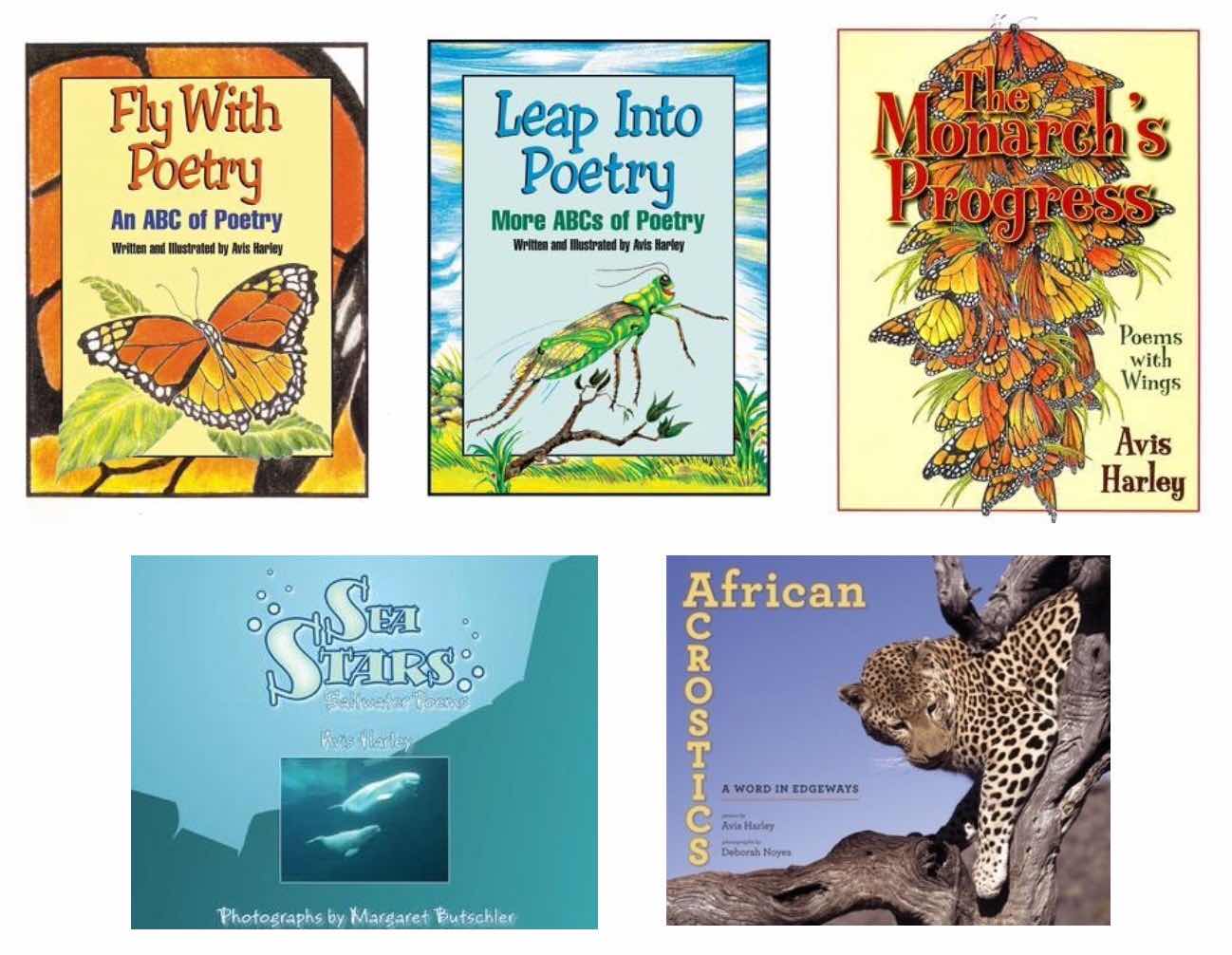
She is most proud of Fly with Poetry: An ABC of Poetry, (2000) "because there is something special about your first published book.
This self illustrated, alphabetically listed collection of different poetic forms begins with an abecedarian poem. Each poem is presented with a description of the format at the bottom of the page. An illustration references the content of the verse. This collection contains the doublet, turned into a poetic form by Avis, where a word is changed, one letter at a time, into another word.
She also created the "Intravista” which was introduced on Sylvia Vardell's blog, Poetry for Children.Avis defines an Intravista as "words within words, arranged vertically, to make a poem within a poem. (The word Intravista has a word tucked inside it!)
How fine a thing am I to be all wing and eye!
A companion book, Leap Into Poetry: More ABCs of Poetry (2001) continues with another twenty six poetic forms, each of them highlighting a different tiny creature. In Sea Stars: Saltwater Poems, Margaret Butschler's gorgeous photographs of ocean life are accompanied by Avis' delightful poetry. The back matter contains additional information about the species in the images. I was never an acrostics fan until I read African Acrostics: A Word in Edgeways by Avis Harley and photographer, Deborah Noyes. The book pairs photographs of African animals with delightful acrostic poems. This is not acrostic poetry with one almost unrelated word for each letter! In these examples of different kinds of acrostic poems you will forget you are reading acrostic poetry. I had no idea there were so many variations! You can read how I used it with a group of students here. I've highlighted the letters to read vertically so you can see that there is a poem inside this poem.
Eyes read what ears hear.
Another self illustrated book, The Monarch's Progress: Poems with Wings, contains different forms of poetry that inform readers about these magnificent creatures. Harley's work has received many awards and accolades. She is most pleased with African Acrostics being named one of the best books of the year by the New York Public Library. It is in its 8th printing! These days Avis has a work in progress about having fun with collective nouns. She showed me a gorgeous self illustrated book about bees that needs to find a publisher. Avis is a role model for how to age with grace and dignity. When not writing, she keeps herself very busy. For the past 40 years, I have been very involved in two lively book groups, reading a wide variety of fiction and nonfiction and thoroughly enjoying the animated discussions at meetings. Avis is also involved with the Women's Probus Club of Vancouver, and volunteered with the after school music program at St. James Music Academy. Once an avid hiker, she's now part of a walking group that meets daily from 8:15 to 9:15. Birds fascinate her and she keeps track of all the different species who visit her spacious back yard. I suspect she makes the most of birding when she visits Salt Spring Island, her favourite vacation spot. Every Christmas Eve, Avis and her family sit down together to watch her favourite movie, Alastair Sim in Dicken’s “A Christmas Carol.” She regularly attends opera and live theatre. Her favourite music is Chopin’s piano compositions and Saturday Met Broadcasts. "Music has been a major influence in my life. I have fun with the ukulele, and I take piano lessons, took voice lessons in my youth, and sang for many years in the Vancouver Opera Chorus. The combination of words and music and how everything comes together to create such harmony has always thrilled me." (Please note that I put those words in bold to help you figure out what she is passionate about. She still practices her piano every day.) If you could change one thing about the world, what would it be? From the start, every child would receive quality education. This would mean that education in the arts and music would be as important as learning about math, literature, history, and science. if you haven't figured out what Avis Harley is passionate about, aside from poetry that is, here is your last clue in a poem I scrabbled together using her work as mentor text.
Mastery of the keyboard Underpins Success at the piano, but Integrated voices are a holy Commune wherein the sacred rings I leave you with Avis' favourite quote about poetry: "Poetry begins in delight and ends in wisdom" Robert Frost
If you want to learn more about Poetry Friday, click here. Leave your links below, and let's get this party started!
Poetry Friday is hosted today by Tanita S. Davis at [fiction, instead of lies]. If you are interested in The New Year’s Poetry Challenge, check out the information on her page. Don't forget to check out the links to other participants sharing poetry today. I had big plans to write a blog post on the winners of the CBC poetry prize this week. Two important things got in the way. First, I didn't finish reading the entries, and second, I finished this collection of poetry by Robert (Bob) Heidbreder. He wrote it after the death of his mother - claims it was the best grief counselling ever.
I adored it! It was like visiting with my mother in law and her bridge and coffee klatsch gals. These are lines of pure, sweet magic.
Poetry Friday is hosted today by Bridget Magee at wee words for wee ones. She's sharing her experiences of trying to host a Thanksgiving dinner in Switzerland where she now lives. Don't miss her turkey poem! Don't forget to check out the links to other participants sharing poetry today. I have been contemplating Michelle Barne's Little Ditty challenge since the beginning of the month. I thought playing around with language would be simple. After all, I do it a lot with my grandchildren! My husband and I are lucky to live with my son, his wife, and Ada, their two year old daughter. When Ada and I are out and about together, we mess around with language. Some of this is about rhyming games I create to help her pronounce words more clearly. Other times it’s for the shear joy of basking in our magical power over words and sounds. Recently while we were traveling in the car she entertained herself by creating her her own rhyme. I heard her sing song chanting roly poly, roly poly, roly poly. Then she shouted from her car seat, "I did it! See Gramma! I did it!" She played with those words while I beamed with pride and listened intently from my driver's seat. It ended up something like this. roly poly roly poly roly roly poly roly roly poly up up up down down down roly poly roly poly roly roly poly roly roly poly round and round by Ada aged 28 months It wasn't until later that I realized it was her version of a song she learned in story time at the library. I still think she's brilliant. Soon after Kate O'Neil's challenge I was walking to my car in the Costco parking lot. The late afternoon light emanated a scene from The Birds. Sky, bushes and trees were thronging with cawing crows. Watching them congregate on their daily migration home in the evenings is an ordinary occurrence here, but I have never been in the middle of it before. Experts estimate that between 13,000 to 20,000 crows converge at the rookery near where I was. The following video gives you a sense of what it's like.
After gazing starstruck by the spectacle, I crawled into my car and scribbled a collection of words. It still took what seems like forever to come up with this draft. Crow Magic it’s a caw caw caw cawcophony of crows it’s a caw caw caw cawnjure of corvids it’s a caw caw caw cawreening cawnga line it’s a swoop loop troop whooping home to bed it's a caw caw caw cawniferous cradle it's a sh sh sh shnoozing roost of crows Happy Thanksgiving to all you American contributors to Poetry Friday!
Poetry Friday is hosted today by Rebecca Herzog at Sloth Reads. She has written a delightful poem about salad. It sounds delicious, except I imagine my arteries clogging just reading the recipe. Don't forget to check out the links to other participants sharing poetry today. My father would have been eighty seven today. He and my mother were on their way to a Masters' Bridge Tournament in San Fransisco when he had an aneurysm and died. He was fifty seven. He was injured in a logging accident when he was only twenty five. Although he recovered, he used a wheelchair for the rest of his life. I wrote this poem for him awhile ago. I added the last stanza recently, because my father survived that tragedy and came out the other side a better person than he might have otherwise been.
Tribulation My father was a logger, a high rigger, a faller of stoic giants. It's perversely fitting that one of them felled him My father was handsome: a tall, blonde, Nordic god, heir to kingdoms of possibility. When gods fall, they fall hard. My father couldn’t climb up into his before. He raged against his impossibly broken body and let dark descend. My father took years to climb up out of that dark into the sunlight of a new life. Vestiges of it left him volatile and humbled, our hero.
Poetry Friday is hosted today by Tabatha Yeatts: The Opposite of Indifference. If you are interested in a writing retreat for yourself, Tabatha has information for how to accomplish it! Don't forget to check out the links to other participants sharing poetry today. Last week's post was all about the creepiness of Halloween. I have been working a lot this week and didn't expect to post today. Then I saw this picture of my two grandkids. The poem wrote itself.
Poetry Friday is hosted today Jama at Jama's Alphabet Soup. Jama is an "author, blogger, foodie, alphabet lover, picture book nerd, soup maker, bear collector, diehard anglophile and secret wife of Colin Firth." (That's taken from her blog.) I am lucky to be Jama's facebook friend. Each day my feed is filled with gorgeous illustrations from modern and classic picture books. Today Jama is sharing snippets of poetry from Charles Ghigna’s new book, Dear Poet: Notes to a Young Writer. Go on over and take note of the stunning illustrations created by his son. Don't forget to check out the links to other participants sharing poetry today. I had a post ready to go last Friday with Catherine Flynn at Reading to the Core, except for needing a final check and to add details about her post. I woke and went looking for my laptop to do just that. It wasn't where I usually leave it. I searched all over our living room for it. It wasn't under any of our furniture. It wasn't snugly tucked into our book shelves. I even checked the grandchildren's toy shelves. No laptop. I ransacked the rest of the house. No laptop. Being more than halfway convinced that it had been stolen, I phoned Apple and they helped me lock it so all my stuff was safe. As we were planning on leaving town, I gave up and started to pack. My favourite sweatshirt wasn't in the closet so I went to the hamper of folded laundry that I still hadn't put away. There in the middle of the basket under folded clothes was my laptop. By then I had run out of time, so I'm sharing last week's post today. A friend of mine suggested my computer had gone searching for missing socks. Another that maybe the hard drive wanted cleaning. Catherine focused on gratitude last week. I'm very grateful to have found my laptop. A couple of weeks ago Catherine and her Swagger friends showed off their zenos. She explained, "invented by J. Patrick Lewis, a zeno is a ten line form with a 8-4-2-1-4-2-1-4-2-1 syllable sequence an abcdefdghd rhyme scheme." Having a penchant for patterns in mathematics, I couldn't resist having a go. I played around with this format off and on. It is much harder than I expected! At first I ended up having too many 4-2-1 sequences. I gave up and figured I'd use them all because I couldn't decide which one to abandon. The good thing about missing posting last Friday is that when I looked at it this week, the words just came together to make the whole poem work.
M's Quilt here stitched with love is Marguerite's quilt patterns dance in white and red spinning centre braided edge gracing now an empty bed I made this quilt for my mother in law who died a number of years ago. My partner and I inherited the house and contents so the quilt has come back to me.
Hi Everyone, and welcome to Poetry Friday. I'm excited and nervous to be hosting today for my first time! Leave your links below and enjoy a special day celebrating poetry.
Now that I'm finished sharing first drafts of my memoir, I’m hoping to highlight Vancouver children's poets on my blog. I want to brag!We have a lot of talent here north of the 49th parallel. I’m beginning with Robert (Bob) Heidbreder. Not only is he one of my favourite local authors, he’s also one of my favourite children’s poets. Reading anything by Bob saturates me with sunshine. His language is all hippity hoppity bibity bopity. It fills my body with rhythm and makes me want to dance. Bob is kind, generous, gracious, funny and smart. He came by for lunch the other day and I interviewed him about his life and work. I wish I was smarter and had recorded our time together so I could quote him accurately. I also forgot to get my husband to take a picture. Next time I interview someone, I’m recording it and adding, get a photograph, to the list. I had a lot of questions. I should add that Bob is very patient. Bob Heidbreder was born in 1947 in Quincy, Illinois. He didn’t take to reading till he was in grade six, but adored the “bounce of poetry.” His earliest poetic influences were memorizable poetry like street rhymes, Mother Goose, skipping and playground poems like Eenie Meenie Miny Moe. He nearly drove his sister crazy by reciting 'Fuzzy wuzzy was a bear' until she screamed. Bob's first book, Don’t Eat Spiders is based on these kinds of poems. Eenie Meenie Manitoba is another. He began writing early and had poetry published in his school newspapers. In high school he discovered W.B. Yeats and Robert Service. Present day favourite poets include: Yeats, Wallace Stevens, and Elizabeth Bishop, especially this poem,
One Art
by Elizabeth Bishop
The art of losing isn’t hard to master;
so many things seem filled with the intent
In secondary school Bob embraced the Latin language and then went on to study Greek and Latin at Grinnell College in Grinnell Iowa. In 1970 he immigrated to Vancouver, Canada to do graduate work in the classics department at the University of BC. A search for a Latin Dictionary introduced him to Jane. They fell in love, got married, and lucky for us, Bob never left Vancouver. Given his classical background, I couldn’t help but ask how he came to teaching Grade One. His response: I was tired of academia. Bob spent thirty years with little ones before retirement. These youngsters brought him back to the rollicking poetry he loved in his youth. At first he only wrote poems that entertained, engaged and educated his students. Then Jane encouraged him to try to get his work published, and the rest is history. He’s been a beloved Canadian poet ever since. He has won all kinds of accolades, awards, and honours; including The Prime Minister’s Award for Teaching Excellence 2002-2003. His classroom work is highlighted in Mr. H and his Unruly Puppets, a documentary directed and produced by our mutual friend, Annie O'Donoghue. (My husband was the cinematographer.) In Mr H's classroom, learning was challenging and fun. "A cast of over 50 puppets, led by the wise wizard Alphaterwa and the unruly Stanley C. Crow, transformed the Grade One curriculum into a year-long interactive drama.” You can watch that video below. I discovered it online recently and will have to report it to the creators. It might not be available for long. I encourage you to take 30 minutes to watch it and be inspired.
On Writing:
Here are some of his writing habits:
Poems are written in his head before writing them down. He works on them while walking or riding his bike. When I asked if he was worried about forgetting, he replied that he trusted his process and if he forgets it, then it probably wasn’t very good anyway.
When a poem is ready Bob retreats to a quiet space where he writes on the computer. He loves the clean look of the poem without all the scratching out on paper.
He is "not a disciplined writer who writes everyday." He works when ideas strike - then he might focus hard on a project for months.
For him, the easiest thing about writing is “Getting ideas.” The most difficult thing is “Working through ideas to the end.” He has a 'sleeping drawer' where he puts manuscripts that are not coming together. They might languish there for years before he gets back to them.
The best advice he's ever gotten is to "Keep at it. Don’t give up." His advice to new writers includes the same advice, with the addition of, "Avoid adjectives. Discover your own voice. Write for yourself."As an afterward, Bob claimed that before you are published, you write for yourself. Afterwards you tend to write to get published.
On Publishing in Canada:
Bob enjoys the stimulation of working with all his editors. A favourite was Sheila Barry, a superhero in Canadian Children’s Literature who is much loved and missed in the Canadian publishing community. He figures it's good that writers don’t get much interaction with illustrators. He wouldn’t expect an illustrator to ask him to change a few words, so doesn’t expect to have a say in how illustrators interpret his books. Only once did he assert that he didn’t think an illustration was in the best interest of a book. Luckily the editor agreed.
In the last few decades we have lost many independent Canadian publishers in general and of children’s books in particular. Kid’s Can Press, originally a local publisher of children’s literature, has now become a multinational corporation. More and more often, Canadian authors are asked to remove aspects of their work that contain Canadian references because they don’t sell in America.
To date Bob has published eighteen books. Some have been rhyming picture books and others are collections of poetry. His books have been shortlisted for, and won, numerous awards here in Canada!
My favourite is Drumheller Dinosaur Dance. This is one of my go to books when I am substitute teaching in primary grades. Students unfailingly love it. Told in rhyming, rollicking poetry full of onomatopoeia, it shares the shenanigans of dinosaurs late at night in a special spot near Drumheller Alberta. The typography dances and sings all over the page in unison with Bill Slavin's and Esperanca Melo's raucous artwork! Every student I've introduced this too has loved to shout out the chorus of, BOOMITY-BOOM RATTELY-CLACK THUMPITY-THUMP WICKETY-WACK. Here it is in the following video.
That final cumulative repeating refrain ends up being
shh - shh
glint - glint
pring - pring
tra - la - la
snap - snap
tip - tap
hoo - hoo
click - click
purr - purr
scratch - scratch
pound - pound
Rooster Summer, his most recent book, is a memoir in verse about his summer holidays with his grandparents on their farm. It's full of magic - the kind that can only be experienced by children in a place full of wonderful animals and doting adults. There's Rexter, the talking rooster; Seed-Sack, the mule who thinks he's a horse; Ginger Tea, the dog; and Tuftin, the cat. Many of Robert's descriptions, like this one, "inside is a bundle of purrs" make me want to swoon. Rooster Summer is a book that will make you nostalgic for a time and summer the likes of which you might never have experienced. Madeline Kloepper's vintage style art is the perfect accompaniment to the poems in the book.
Bob is very busy! Our Corner Store, a companion memoir in verse, is in production with Groundwood. The release date is set for April 1, 2020. He's got a couple of projects in the writing stage and three other books in production:
Catch the Sky, pocket poems about observing the sky, published by Greystone, either 2020 or 2021.
Alphabet Antics, an alphabet book that looks at the shape of letters rather than the sounds, published by Tradewind, date to be announced.
Pianissimo, illustrated versions of musical terms, published 2021 by KidsCan.
I leave you with a few other questions and answers.
Favourite color: “Yellow. It gives me a bright feeling, like wearing a piece of the sun.”
Favourite movie: “Paper Moon.”
Favourite food: “bread, all types of bread”
Favourite vacation spot: Gabriola Island where he and his wife have a cabin and chunk of land
Favourite book: “The Good Soldier because of the unreliable narrator”
Favourite word: growing up, it was Mississippi, but while he was teaching, it was supercalifragilisticexpialidocious.
Favourite music: Jazz. These days Bob’s taking a course, What Makes it Jazz: at the downtown campus of Simon Fraser University.
If you could be someone else, who would you be?
"I'm happy being myself," but wouldn’t mind being a high powered stage actor for a day.
If you had all the world’s children in one room, what would you tell them?
"Let’s see what we can laugh at. Laughter gives us power."
Before we parted, Bob reflected upon the idea that a moment is a poem. Narrative is the accumulation of these moments put together. He also left me with his three R’s of writing poetry:
Rhythm
Repetition
Risk: (As an example he explained: start with an ordinary statement like, 'today I ate my lunch.' Turn it into, 'today my lunch ate me.' )
I decided to play with that and here's what I ended up with:
Today my lunch ate me
I was surprised as I can be
Inside it's tummy I tickled away
Till it spit me out shouting, Go Away! What can you come up with?
I would like to give a special shoutout to Michelle Barnes who has been an unwitting mentor and inspiration to me for the brilliant questions she asks authors!
This is my first time with a linkz. If it doesn't work, please just add your link in the comments section and I will post them here during the day.