Lost Lake by Sarah Addison Allen

Sarah Addison Allen turned me on to magical realism. It is my new favorite genre.

Lost Lake involves generations of women grieving the loss of their husbands. It involves learning new ways of coping with this loss.

There is woman and her child. There is a childhood friend with a secret. There is a mother in law who wants the woman and child to be how she defines them. There is an aging aunt trying to figure out what she wants. There is a man and a woman who have been in love for nearly 40 years, but still haven't done anything about it. There is a friendless woman with charms that make men leave their wives. There is the woman who befriends her. There is an uncle who has lost his humanity. There is an alligator who vaguely remembers being human.

They all come together for one last magical summer at Lost Lake. 

Truths about the human condition are revealed. "Like most small towns, the older generations were the one who kept the secrets, to such an extent that the newer generations were growing up with no idea why they were the way they were."

Truths about living life as a reader are revealed. "The books I read when I was twenty completely changed when I read them when I was sixty. You know why? Because the endings changed. After you finish a book, the story still goes on in your mind. You can never change the beginning. But you can always change the end. That's what's happening here."

Lost Lake is a story about endings. It is about having the power to create your own ending through the support of family and friends.

While there are some magical aspects to this book, the real magic is about the power of friendship, love and community.


Spring Break Reading Challenge


Amidst the fury of the last two days of the Scholastic book fair last week, and in spite of the fact that I already had a pile of my own waiting for me at home, I asked students to come up with a list of book suggestions for me to read over spring break.

Here are their recommendations. 
The Penderwicks series by by Jeanne Birdsall - Every book this kid has recommended to me has been superb, so I plan to read at least the first one.
The Dogs of  Winter by Bobbie Pyron - I accidentally grabbed the The Dogs or War graphic novel from the book fair so I'll have to go looking for this one.
The Lightning Thief by Rick Riordan (I know I'm nearly the only person on the planet who hasn't read the series - I did try to read The Red Pyramid but abandoned it.)
The Selection by Kiera Cass
The Titanic Locket - I think this is the first in the The Haunted Museum series. I need to search for this one too. 
Go Ask Alice - our copy was out - Ill have to see if I can find one at the VPL 
Magyk by Angie Sage - It was suggested I read the entire series, but I'm starting with this one
Bad Unicorn by Platte F. Clark - probably one of the weirdest looking book covers I've ever seen - but I'll give it a try
Three Times Lucky by Sheila Turnage - thankfully this was on my list also
Call the Shots by Don Calame
Flora and Ulysses by Kate DiCamillo (I've already read it twice so I'm calling it done!)
The Apothecary by Maile Meloy (thankfully it was also on my list)

My own list includes 
The Runaway King and The Shadow throne by Jennifer A Nielsen
Lost Lake by Sarah Addison Allen
Texting the Underworld by Ellen Booraem
The Archived by Victoria Scwab
The Long Earth by Terry Pratchett
Half a Chance by Cynthia Lord
Letters In the Attic by Bonnie Shimko

I've also got some Audiobooks waiting for me
The Dream Thieves by Maggie Stiefvater (I loved love loved The Raven Boys)
Legend by Marie Lu
Alanna: the First Adventure by Tamora Pierce

I doubt I will get all of these done. I have a garden to work in and family to spend time with, but I'm gonna try for a book a day!

Scat by Carl Hiaasen

There's something comforting about a good mystery. There are good and bad characters. The plot has some suspenseful moments and will keep you guessing. It has unexpected twists and turns. Eventually the forces of evil will get their comeuppance. It's formulaic, but we know this at the outset, and that predictability is why it's safe.

I read Hiaasen's adult work before he started writing for younger readers. No matter the audience, he takes the formula and makes it his own. On top of this, Hiaasen embeds environmental issues into gripping reads so that we are educated as we are entertained. I've never been disappointed in one of his books. Scat is no exception.

It starts out in a classroom where Mrs. Starch, the nightmarish biology teacher, has her students, including our protagonists, Nick and Marta, terrified. Well, all of the students except for Smoke, who chews up and swallows the pencil she points in his face after she has publicly humiliated him. 

Then Smoke is framed for a deliberately setting a forest fire that results in Mrs. Starch going missing.

Villains are revealed trying to drill illegally for oil in protected wilderness and panther habitat. 

There is a baby panther without its mother. 

You might think Nick has enough on his plate with a father seriously injured in Iraq. In spite of, or maybe because of this, he and his friend, Marta, try to figure out what happened to Mrs. Starch. They end up embroiled in a situation beyond their comprehension. 

There are numerous characters. (I admit to being a bit confused at first. It might be because I was listening to this as an audiobook.) Once I had them sorted out, I just settled in for a whopping great yarn. All of them are developed with emerging complexity as the story progresses. 

I look forward to recommending this one to the mystery fans at school. I think it might even convert those haven't yet discovered the comfort in them. 

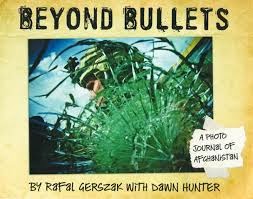
Beyond Bullets by Rafal Gerszak with Dawn Hunter

One of my library monitors told me his stepdad had written a book on Afghanistan and so I asked if he would loan it to me to read.

I received it the next day.  I started browsing the first page and knew in those few moments that this was not a book to peruse distractedly. Already I was about to cry. I asked for permission to take the book home so I could read it at my leisure. Last evening I sat down and read it.

Rafal Gerszak is a photojournalist who has been to Afghanistan a number of times. This book reflects those journeys and reveals multiple perspectives on the conflict there. It is a difficult read.

The first part of the book deals with his experiences while embedded with a platoon on the front lines. The writing is simple but powerful. His description of travelling in a Humvee in the heat puts us right there, "it's like wearing full hockey gear and sitting in a sauna--times ten. The armor we wear doesn't breathe at all, plus we wear helmets and gloves (which are fire retardant so that, in case of an explosion, we don't burn our hands; plastic gloves would melt to our skin.)" And that is just the beginning. In this section Gerszak takes us through ambushes, searches through private homes, military hospitals,  humanitarian aid drops and rocket attacks. When a child dies despite heroic efforts of people on all sides of the conflict,  we see clearly that "This girl had nothing to do with the conflict, but everything to do with what's wrong in Afghanistan."

The second part of the book reflects Gerszak's time spent with Afghani people.  There are some truly sublime moments - like the day spent at Qargha lake on the Muslim day of rest. What I learned from this section is that in the midst of the hell of war, people try to live ordinary lives just like you and me. There are aspects that will break your heart: life in a refugee camp, the hardships of medical volunteers, watching children die in a hospital, a conversation with a suicide bomber, child labour, and the situation for women and girls.

My aging eyes had a bit of trouble with the contrast between the page colour and the font, but it wasn't overwhelming. I appreciated the boxes on some pages giving me additional information to help me put Gerszak's experiences into context.

The content is heavy and disturbing, but an eye opening read. I will most certainly get a copy of this book for our library.

Frogspell by C.J. Busby

Before I started reading this book I had just finished American Gods by Neil Gaiman (a book for grown ups). I was afraid to read anything because, seriously, when you finish a book that stunning, nothing in the world will compare.

On account of this, I decided to go for a book where I had few expectations. Frogspell is a novel for students just into reading chapter books. I figured it probably wouldn't be overly complicated or rich, but hoped I could recommend it to boys and girls who are just moving into reading this kind of book on their own. The best thing about having no, or negative expectations, is that you can be pleasantly surprised. And I was!

It's a simple tale set at the time of King Arthur. It begins with Max Pendragon working out a new spell for the Novice's Spell-Making Competition. Right off the bat we learn a few important things about family dynamics at the Pendragon household. First, although his wife, Lady Griselda, is a witch, Max's father, Sir Bertram, does not much like magic. Second, Sir Bertram has traditional gender expectations for his children. Third, Max has a bothersome little sister, Olivia. Fourth, accidents seem to happen when Max is around magic. 

It is a fun read. Accidentally, the potion Max was trying to create ends up turning Olivia, Max's pet rat, Ferocious, and himself into frogs. After some hilarious  and nearly disastrous moments, they figure out how to reverse the spell.

When the family heads off to Castle Camelot for a festival and 'The Competition,' the children soon discover that mischief is afoot. They uncover a plot to kidnap King Arthur's son and set Lady Morgana le Fay in control of the kingdom.  Max and the rest of them have to come up with a plan to save the prince before disaster strikes. 

What I liked:
I liked that there was lots of action in the plot. I liked the humor. I liked that both the children felt constricted by the expectations their father has for them. The many kinds of characters are developed enough to be interesting, and make the reader want to find out more about them. I like that the ending, while satisfying, sets the reader up to anticipate the next book in the series. This is good because then all I have to do is get them started on the first!

I worry a bit that kids won't get all the historical nuances referenced here, but I don't really think it will matter in the long run. If they liked these, then I can introduce them to move complicated Arthurian legends all in good time.

I plan to pick up the next two in the series, Cauldron Spells and Icespell at the Scholastic Book fair in the library this week.

Darius and Twig by Walter Dean Myers

"All of fiction is truthful. What you create is your own truth and no one can take that away or change it." - Walter Dean Myers

I love this book. I love these boys.
Darius and Twig are best friends. They are growing up in Harlem and dreaming of ways out. They live inside a world filled with layers of pain. It isn't easy. They have to cope with bullies and gangs. The have to overcome poverty and alcoholic parents. There is violence and guns and drugs. They have to figure out who they can trust.

These boys are smart. They know they have gifts that might help them get out of the world they are in. Darius is a young author on the cusp of being published. Twig is a long distance runner. Still, without one another, they are lost. Even then it's iffy. "Twig thinks I am growing dark, and he is right. He wants me to live through the pain. I don't think I can." They know they can trust each other to be supportive at the same time as keeping one another honest and true.

They are aware that the odds might be stacked against them. "The chorus in school was that if you did the right thing, that if you worked hard you would succeed. And how many worlds was that true in? Was it true in my mothers world? Was it true in my fathers world?" Can these boys do it?

I like that Myers posits significant adult characters to act as understated role models and mentors. At school is Miss Carroll, the writing teacher, and Mr Day, the coach. At home, two charming old men, Mr Watson and Sammy Hines, hang out on the stairs joshing each other, and offering up advice and support to the boys and the neighbourhood. It does indeed take a community to raise a child, especially in these kinds of circumstances.

Walter Dean Myers' writing is heart stopping glorious. Every once in a while I experience it at a visceral level and am filled, simultaneously, with darkness and light.

Some quotes will haunt me for a long time.

"That's one thing we get to be good at, be quiet when we are hurt."

"Maybe the boy did have faith in the dolphins. He had just lost faith in everything else"


I'm definitely getting a copy for our library. 

★★★★


Picture Me Gone by Meg Rosoff

It is sad that the use of one word in a novel can taint the rest of the work, but for me, this is the way it is. Early on in this book, Mila, the main character and narrator, uses the word squaw in reference to a Native American woman. Whatever the word's origin, it has too often been considered a derogatory term. Here in a modern children/teen novel, it has no place. It depresses me that none of the editors or early readers commented upon this and had it changed to woman.
It's even sadder that there are many aspects to this book that I liked. Let's face it, Meg Rosoff can write. There is a harsh dreaminess to the winter landscape setting.  The characters are realistic. I've worked with enough gifted children to see this truth in Mila. The many relationships between parents and children are finely crafted and tangible. 
While on the surface there is a mystery to be solved, this is really a coming of age novel. There is a time in childhood when we lose our faith in the infallibility of our parents and adults in general. Eventually their secrets are revealed in all their messiness. This is what happens to Mila. 
Sadly, if not for the use of that one word, I would probably get this book for our library.