Showing posts with label Black Canadian. Show all posts

#IMWAYR January 29th, 2024

 Welcome! It's #IMWAYR time again, when bloggers share what they have been reading and find out what others have been up to. Kathryn hosts the adult version of this meme at Book Date. Kellee and Ricki at Unleashing Readers host the kidlit rendition. These are fabulous places to start your search for what to read next.

Winter finally arrived and for two weeks we had snow and unusually cold weather. Then it warmed up. One day we had snow all over the ground and by the next afternoon it was almost gone. Now we have low cloud, fog, and rain. I'm not complaining. We need the moisture.
According to Goodreads, I am two books behind schedule. I figure it's a small miracle that I'm only this far behind. Between having a houseguest for a week, and then coming down with a sinus infection, it's amazing I managed to read at all.
Because of the sinus infection I missed a quilting workshop, but luckily had all the information already so I just sewed on my own at home. The workshop taught a relatively easy strategy for creating bargello quilts. I made two cushion covers instead of a quilt. Now that they are finished, it looks like we need a new sofa. 


Titles with a 🍁 indicate this is a Canadian or Indigenous Canadian Author and or Illustrator.
Clicking on the title will take you to the Goodreads page of the book.

PICTURE BOOKS

5 stars

NO! Said Custard the Squirrel
by Sergio Ruzzier
September 6, 2022

Don't ask me what this book is all about because I'm still trying to figure it out. I really wish my grandkids were here so I could read it to them and we could talk about what they think. 
Custard the Squirrel looks a lot like a duck, but when asked all kinds of questions about his identity by a little rat in a diaper, he consistently replies no. 
Is this a celebration of being who you truly are? Maybe. 

MIDDLE GRADE NOVELS

4 stars

The Portal Keeper 
The Misewa Saga #4 by David Alexander Robertson October 10, 2023  🍁

"Morgan and Eli are Indigenous children who discover a portal at their foster home to another world, Askī; there they discover talking animal beings who connect them to traditional ways, as well as help them deal with the challenges in the real world. A fantasy for readers aged ten and up, the Misewa Saga (“misewa” is Cree for “all that is”) series reflects stories of the sky and the constellations held within its great canvas."
 Eli, Morgan, and her friend, Emily have located another portal into Aski. They end up in World's End,  a different place than usual, and discover that something terrible is happening to the animal people there. Back in their own world they are horrified to discover what is going on and must come up with a way to save them. 
This is my favourite series by Robertson. I like that we have two queer characters, but it's not all there is. I like the closeness of the two foster children. I like that Eli is coming into his own kind of super power. 

4 stars

The Oceans Between Stars
Chronicle of the Dark Star #2 by Kevin Emerson & Kevin T. Collins (Narrator) February 13, 2018

I read the first in this series ages ago and finally got around to reading the next one.
Liam and Phoebe are two teens who barely escaped with their lives when Mars, the planet they were living on, exploded. They are travelling in stasis with JEFF, their panda shaped robotic  assistant, as they try to catch up to the main ship and reunite with their parents. When they finally arrive, they discover their family's starliner has been destroyed.
Phoebe has secrets of her own. In the prelude we learn that her real name is Xela and her family ended up on Mars when their planet of Telos was destroyed in a ball of fire by humans. She and her people want vengeance. At the same time, she and Liam have become close friends. He accepts her when she finally reveals her true self. Unfortunately she is still keeping some dangerous secrets.
I liked so much about this book. I appreciate that nothing about space and time travel is dumbed down for younger readers. I appreciate the connection between what happened on Telos and colonialism here on our real world. It feels realistic that the two children who want to end the conflict between their two peoples, are mostly ignored by the adults around them. 
If I didn't already have so many books to read, I would probably have started on the final book in the trilogy right away. 

MIDDLE GRADE GRAPHIC NOVELS


This is a profound novel about losing a friend. When a member of close knit group of girls dies suddenly, the remaining girls deal with grief in different ways.
The story is based on the death of one of the authors’ friends. It’s set in the same town as where they grew up. I like that each character is based on one of the local animals of the area. 

YA/ADULT GRAPHIC NOVELS

5 stars

In Limbo
by Deb J.J. Lee March 7, 2023

In this gorgeous, debut graphic memoir, Lee shares her story of growing up Korean in America. It's a painful story of trying to fit into a world where you are an outsider.  While her mother was supportive of her desire to create art, she was prone to violence and physically abused Lee. Her father let it happen. As her close friend began to distance herself she became increasingly insecure and depressed. By the time she graduated from high school, she had attempted suicide twice. 


For me, this Canada Reads title was a window into a world I scarcely new existed. It's a compelling narrative that reads like a collection of short stories with the same main character. It starts with a young Congolese  girl, Loli, shaving her head in order to pass a boy so she can get into Canada. This sets the stage for a gritty exploration of gender, sexualization of girls and women, mental health, and poverty. It's also a story of resilience and overcoming. It isn't for the faint of heart. 


This continues the story of John Bachelor, a character first introduced in the novella, The List. His many screwups have left him in financial straights. When a couple of Dogs (the service's internal security division) from MI5 rough him up and tell him to find one of the retired spies he's supposed to be minding, he thinks he might be able to find his way back into the good graces of the agencies leader. He's wrong of course, but the machinations of all the actors makes for a great read.

CURRENTLY

Eve: How the Female Body Drove 200 Million Years of Human Evolution by Cat Bohannon

Almost Brown: A Mixed-Race Family Memoir by Charlotte Gill

UP NEXT (MAYBE)

Moon of the Turning Leaves by Waubgeshig Rice

READING GOALS 

#MustRead2024 2/25 one on the go

NonFiction 1/25 one on the go

Canadian Authors 3/50

Indigenous Authors 1/25 

Goodreads Reading Challenge: 13/200 

#IMWAYR January 24th, 2022

Welcome readers! It's #IMWAYR time again, when bloggers share what they have been reading and find out what others have been up to. Kathryn hosts the adult version of this meme at Book Date. Jen at Teach Mentor Texts and Kellee and Ricki at Unleashing Readers host the kidlit rendition. These are fabulous places to start your search for what to read next. 


Just a reminder that if you are participating in the #MustRead challenge, Leigh Anne Eck at A Day In the Life is hosting the last update for 2021 here. When you are ready, post your #MustReadIn2022 goals here. The links are open until the end of January.

Titles with a 🍁 indicate this is a Canadian or Indigenous Canadian Author and or Illustrator.

Clicking on the title will take you to the Goodreads page of the book.

4 stars

Ducks!
by Deborah Underwood & T.L. McBeth (Illustrations) Feb 11, 2020

A young duck gets distracted by a butterfly. When it thinks to go back to it's flock, they have disappeared. As they go in search of them they find lots of clues, but NO DUCKS. I love T.L. McBeth's minimalist illustrations. The expression on the little duckling's face is delightful.


My sons were fans of Richard Scary books. This is a lot like those, except with a whole lot more humour. (Children might not get all the puns, but their parents most likely will!) I imagined reading this with my 4 1/2 year old grandchildren. I’m pretty sure they will love it.
If I was still in the library I would probably get a couple of copies of this to support primary teachers who do community projects with their students.

NONFICTION 


This biography is visually stunning. I adored it. The images, combined with the straight forward, easy to read text make it a model for what nonfiction texts for elementary and middle grade readers should aspire to be. I read it a couple of times and each time I was more impressed by it. "It takes young readers through Anning's many fossil finds and scientific breakthroughs. At the same time it doesn't stint about the hardships Mary and her family endured. It makes clear the challenges she faced because of her poverty, gender and class." 

GRAPHIC NOVELS

These days I'm mostly reading graphic novels for the Cybils awards. I will do a post to share my thoughts on all of them after we pick a winner. From the ones I've finished so far, that's promising to be a daunting task. 

Here's what I read last week. If I previously reviewed the book, I've provided a link to it.


Jukebox
by Nidhi Chanani June 22, 2021
    My original review is here. 


Measuring Up
by Lily LaMotte &  Ann Xu (Illustrations) October 27, 2020
    My original review is here.


NOVELS


I listened to the audiobook and was mesmerized by the writing, the story, and Dion Graham’s narration.

Washington (Wash) Black was born into slavery on a plantation in Barbados. The brutality he grows up with is horrific. When he was just a boy, Christopher, (Titch) the plantation owner’s brother, takes him on as his assistant. He teaches him to read and introduces him to scientific thinking. It turns out that Washington is a gifted artist.
Wash is present when a cousin of the brothers kills himself. Knowing his brother will blame Wash, Titch and Wash flee the plantation. They travel to America and, fleeing a relentless slave catcher the brother has sent after them, end up in the Arctic where Titch abandons Wash, who is still a child.
There are more journeys in store for Washing Black. To start, he leaves the Arctic and ends up in Nova Scotia.
As he grows up alone, Wash becomes a young man searching to figure out who he is, who he can be, and how he fits in the world. It’s an almost impossible task. He finds some peace, but all the while he’s haunted by Titch’s abandonment and lives in fear of the slaver catching up to him. As a black man with a disfigured face, he’s easy to track down. Even when he connects up with another scientist and his daughter, he’s never really acknowledged as a human being with the right to be recognized for his own work.
The ending left me heartbroken.
There is so much in this novel to unpack. To start there’s the relationship between the captured octopus and Washington. Then in tandem with the author, take a hard look at who Abolitionists were and explore the contradictions between what they said and how they acted. 
I wish I had read this with a book club.

PS - Esi Edugyan has won two Giller prizes (this is one of them) and her books have been nominated for for many more awards.

MEMOIR


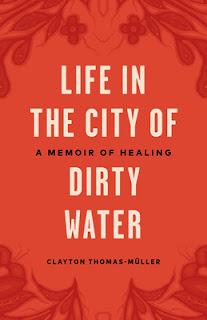
Learning how people come to be the people they are is always fascinating. I really appreciated Clayton Thomas-Muller's brutal honesty in this. His life was full of hard things - some are difficult to read about. He didn't always make the kinds of choices people might think are the right ones, but he's come out of it being a staunch environmental activist at the same time as working hard to become the best person he can be. The first part of the book deals with his early years and the second half focuses more on his activism. In many ways his story is the story of Indigenous rejuvenation, reclamation, and celebration.
Reading reviews about this book is interesting. Some readers complain it is too much about his activism. Others say it's too much autobiography. I think the intersection of these two make it just right. 

CURRENTLY

What Strange Paradise by Omar El Akkad & Dion Graham (Narrator) 

My Last Summer with Cass by Mark Crilley  (Cybil title)

Spílexm: A Weaving of Recovery, Resilience, and Resurgence by Nicola I. Campbell

UP NEXT 

Everyone Knows Your Mother Is a Witch by Rivka Galchen

Nubia: Real One by L.L. McKinney & Robyn Smith (Illustrator) (Cybil title)

I have almost finished reading and rereading the finalists in the graphic novel categories in my role as a round 2 Cybils judge. I'm looking forward to finding time for other books.

READING GOALS

#MustReadFiction 2/24 

#MustReadNonFiction 1/18 one in progress

Canadian Authors 5/100 one in progress

Canada Reads Longlist 5/23 one in progress

Indigenous Authors 2/25

Goodreads Reading Challenge: 26/250

Saga Boy: My Life of Blackness and Becoming by Antonio Michael Downing

Thanks to NetGalley for the opportunity to read and review this book. This crossover YA/Adult title will be released January 19, 2021, by Penguin Random House Canada.

"The Queen designed my brain." is the first sentence in this four part memoir. It is a critical statement hinting at the ramifications of colonialism and the implications of it at an intimate level.

The most important thing about this book is the exquisite writing. Every page is full of swoon worthy prose. I ended up highlighting line after line - way too many to begin to share all of them with you in this review.  

Please forgive me if I've gotten carried away with the quotes.

I will never be able to do justice to the beauty of Downing's words. 

You will have to read it yourself. 

The book is organized into four acts. Each act references a specific time in his life and the different person he was in each of them. 

Act one: Tony

Until he was eleven years old the author lived in Trinidad with his older brother, Junior, and Grandmother who they called Mama. The rest of the community called her Miss Excelly. Mama was a deeply religious woman who gave generously of her love, time and whatever she had, trusting that whatever she needed would come back to her. The gifts she gave Tony would enable him to survive what hell he would end up facing, including the abuse he endured from a neighbour there. Downing wasn't aware of the gifts then, but it's there in his writing when he writes about coming home from school. Mama was always singing. Tony was greeted by it every day. "Her voice perfumes the very air... All of creation became her voice calling me home."

Tony was a excellent student who loved to read. As he read from the white canon of literature, "what unfolded page by page, battle after battle, image after image, was the great river of things that explained the world." He came to understand "the golden rule: there was a place called white, and it was always better." 

He was attending a prestigious school when Mama died. 

Act Two: Michael

At age eleven, Tony and Junior were taken from Trinidad to Waubigoon, an indigenous community in Northern Ontario. They lived with their Aunt Joan who was a social worker working with the people there.

Tony became Michael. His first teacher was a nightmare. Not only did she change his name, she tested him and recommended he be put ahead two grades. I gasped as I read this - already seeing the disaster this was likely to become. I remain angry thinking about how different things might have been for him had he been allowed to remain with his peers. 

He became increasingly isolated: not fitting in with his classmates or the white or the indigenous community. At the same time, even at his young age, he understood he was more connected to the latter group than either of the former. While attending a PowWow he acknowledged that the Indigenous people were as much victims of racism and colonialism as he was. He also came to understand that their power and strength had not been completely destroyed, "they were still here. They were still part of the land." 

Aunt Joan, who knew much about the boy's background, tried to do her best by them. She understood that Michael was 'fragile and explosive.' Still, she allowed Junior to be sent away to go to a prestigious school in the United States where his Aunt Agnes would become his guardian. Agnes then abandoned him, just like she had abandoned the boys' father when he was in her care.  

Joan tried to stop it, but when Michael was twelve, the two boys ended up going to live with their father and stepmother, Al and Hailey. 

There is a pattern to Downing's writing that make me ache for him. It is full of the most endearing moments and memories. Then the next line lets us know they are only fleeting. Writing about a time with his father he shares:

"he would listen to what I had to say. He cared about what I thought. My father- the man I knew only from photos and tales- cared what I thought. I eased back in the seat and tried to lean like he did, sneaking peeks to make sure I got it right. I studied the hair on his face where he had shaved that morning, the brown tinted sunglasses the obscured his eyes but not his vision, and the confidence, as if nothing as square as worry had ever touched him. The way laughter would jerk and explode out of him in a spasm, as if he were four years old and hitting a bike rim with a stick as he dashed down Monkeytown Third Branch. It was the first time I had felt that close to him.
It was also one of the last."

Al and Hailey were addicts. "Living with addicts is like living with zombies: you never know whether they'll eat you or ignore you."  They only wanted the boys for the government money they brought in.

The beginnings of who he could become is hinted at when he writes a 'choon' that is sung by Junior's band. Over time Junior spent increasing amounts of time away from home. Eventually he moved out and became "a space I no longer recognized." Michael escaped the lonely craziness of his homelife by retreating into words and songs. He didn't understand that these were the same things Miss Excelly had needed to survive: "how to read and how to sing." 

Eventually Michael moved in with Ami, his father's second wife. While there he connected with his two younger half brothers and joined the basketball team. Ami, a white woman, worked hard and did her best, but could barely make ends meet, never mind feed an athletic, growing, always starving teen. 

On a basketball trip he responded to the racist bullying of his white teammates and ended up being the one who got suspended. He writes, "I had always understood the pecking order of our basketball team. Certain boys were always given the benefit of the doubt. There was a place called "white:" and it could get away with murder."

Thankfully Coach Barry Lillie and his wife, Elaine, invited him to live with them. Eventually he became part of their family and ended up getting into the University of Waterloo. 

During this time he reconnected to his mother, Gloria and more of his half siblings. He ended up responsible for the reunification of his parents. In the end, it ended up in disaster. 

When he was cut from the university basketball team, he was left with an unfillable void. Downing writes, "basketball had fathered me. I had soaked up second hand daddying from my teammates. Between the sweaty practices, the nail-biting games, and the breathless sprints, I had absorbed the lessons their fathers had taught them."

A new friend, Chachi, introduced him to art and helped him fill the emptiness. Spending time together, Downing wrote while Chachi painted. 

Act Three: Mic Dainjah

Transformed into a new person again, Downing hid from his damaged self through running, women and music. On the surface he was successful. He worked for  Blackberry and became a Canadian citizen. 

As Mic Dainjah, he was the lead singer of a band called Jen Militia. When he was performing he "vanished to a place with no father, no mother, no corporate bosses, no good kids to keep up with - just the certainty of being alive and somewhere I belonged."

Anger simmered beneath the surface. After hitting his girlfriend, he ended up in an anger management program. He writes about this time with brutal honesty. It's loaded with sympathy and empathy for his peers in the program. The men had to take responsibility for their actions, learn to recognize their triggers and de escalate situations. He writes powerfully about acknowledging guilt and shame. This treatment program helped him, but it wasn't enough. It would take much more therapy before he would be able to heal himself. 

He continued to spend time with Elaine and Coach, his unofficially adopted father. But acknowledges that, "Even after fifteen years, it was still disorienting to be loved by them" 

Act Four: John

In this section Downing writes about his ongoing therapy and coming to the realization that 'while I was busy hiding from myself, words and music had saved me. I was still living off an old lady's prayers." He begins to deal with, "the monster lurking at my core." He begins to tend to the little boy who doesn't feel good enough. 

Of course, recovery isn't instant. 

Many friends helped Downing survive. Gada Jane's introduction to the art collective was an important part. Working with her on the John Orpheus project was another. Everyone needs someone who will tell them, "you are enough on your own."  

His friendship with Howard was instrumental in leading him back to Trinidad and a feeling of belonging. The little boy inside him started to become whole again with Howard's help. 

This book translates the global ramifications of colonialism into an intimate level. It's a story about abandoned fathers abandoning their sons who in turn abandon their own children. It's about the power of women who are the"mules of the empire, forced to carry the burden of the Crown's dreadful legacy, of black bodies chained to the spines of ships, of broken families, of men disempowered, stripped of their status in the home, sent to roam the earth with only their sex to prove their manhood, slaves by blood and by circumstance, saga boys."  It's about trying to fit into a mould not made for you. It's about searching for love, family, and home. It's about learning to love and learning to forgive. It's about becoming who you are. 

Over the space of eight years Antonio Michael Downing lived in six cities, went to six schools and had six different guardians. It could have decimated anyone, never mind a Black youth who, on top of all that, had to deal with a history of abuse.

The miracle of Antonio Michael Downing is not that he became a successful professional and artist after all he experienced, but rather that he survived at all. 

I raged and wept many times while reading this book. I am left thankful for the gift of learning a bit about what it means to be a Black Canadian from Trinidad. I hope to be a better ally after finishing it. 

While reading this memoir I spent some time watching John Orpheus music videos. I hope you enjoy this one, from a new album he is working on, as much as I did.